



Table of Contents
- Introduction
- Should you use vitamin C in the morning or at night?
- Where vitamin C belongs in the order of application
- How often should you apply vitamin C?
- How vitamin C fits with other skincare ingredients
- A practical morning routine with vitamin C
- Match your brightening care to what you see
- Troubleshooting vitamin C application
- Conclusion
- FAQ
Introduction
Use a vitamin C serum in the morning, after cleansing and before moisturiser and sunscreen, unless its own directions specify otherwise. This places its antioxidant benefits alongside your daytime sun protection while supporting a brighter, more even-looking complexion. Evening use is also an option for formulas designed for it.
The important distinction is between the ingredient and the finished product. A lightweight vitamin C serum, an oil-based treatment and a vitamin C moisturiser do not necessarily belong in the same step. Getting the timing right means considering the formula, your other products and how comfortably your skin tolerates the routine.
Should you use vitamin C in the morning or at night?
Why morning is the usual first choice
Vitamin C is an antioxidant. It helps neutralise free radicals, unstable molecules generated by processes including exposure to ultraviolet radiation and pollution. These contribute to oxidative stress, which is associated with visible skin ageing.
Morning application puts that antioxidant care into your routine before daytime exposure. Topical vitamin C also supports a brighter-looking complexion and can help improve the appearance of uneven pigmentation and fine lines over time. These benefits depend on the formulation and consistent use, not simply the presence of vitamin C on an ingredient list.
Vitamin C and sunscreen have complementary roles. Sunscreen reduces the amount of UV radiation reaching your skin; vitamin C helps address free radicals. A vitamin C serum does not have an SPF unless the finished product has specifically been tested and labelled as a sunscreen.
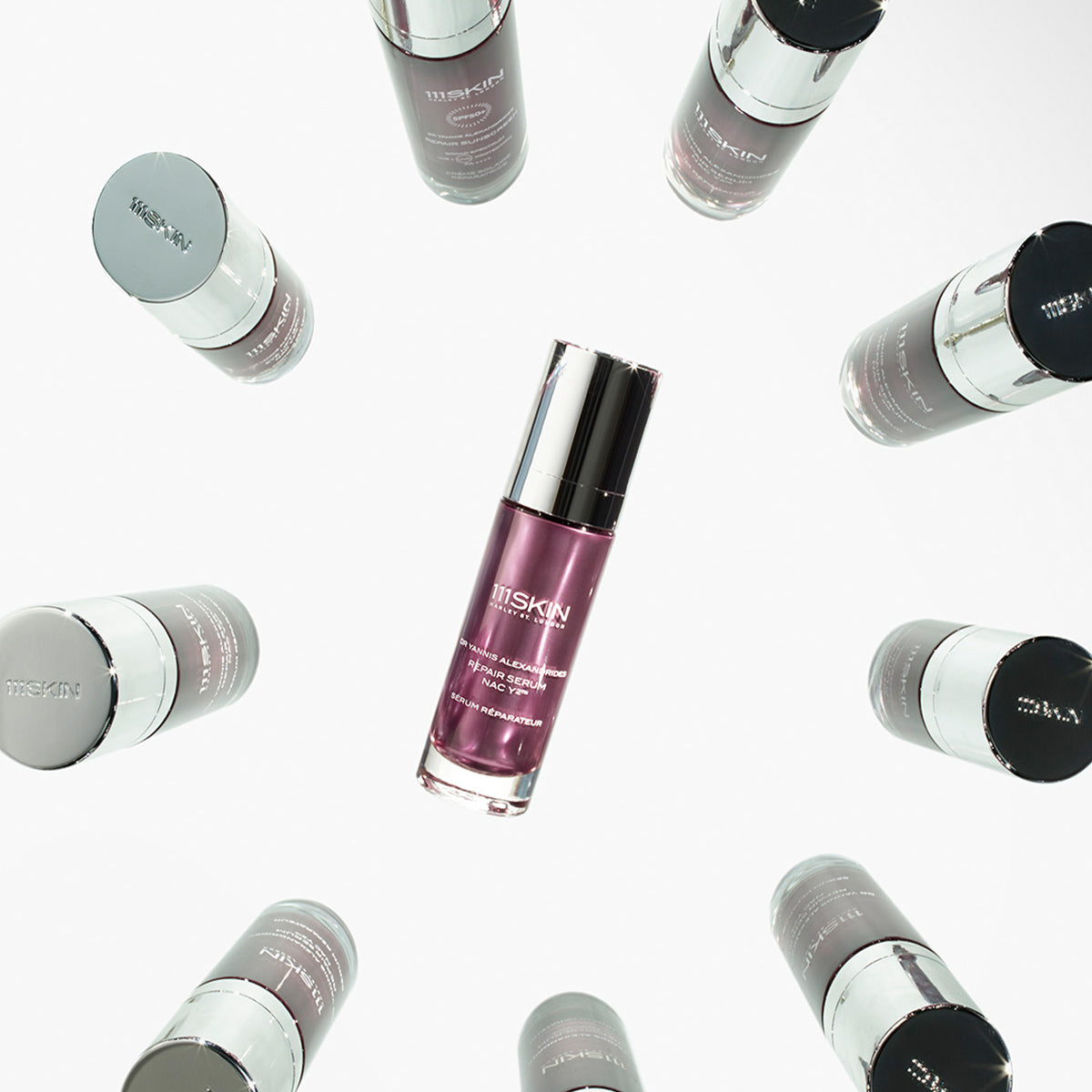
Keep sunscreen as a separate, generous layer after moisturiser. Repair Sunscreen SPF50+ should be applied evenly 15 to 20 minutes before sun exposure, following its exposure and reapplication instructions. Applying vitamin C underneath it does not change the amount of sunscreen you need.
When evening use makes sense
Vitamin C does not stop working after sunset. A formula suitable for evening use can still support brighter, more even-looking skin when applied at night. Night-time application is a practical choice if that is when you can use the product consistently or if its manufacturer specifically recommends it.
There is no need to move a comfortable, effective evening vitamin C routine to the morning at the expense of consistency. Equally, moving a product to bedtime will not automatically resolve irritation caused by its strength or formulation. Skin comfort depends on what you apply and how frequently, not only the hour.
Consider what already occupies your evening routine. If you use several targeted treatments, adding another may make it harder to identify the cause of dryness or sensitivity. A straightforward morning vitamin C step can keep that routine easier to manage.
For a conventional vitamin C serum, start with this position: after cleansing, before moisturiser, with sunscreen applied afterwards in the morning. Let the exact formula's directions refine that framework.
Where vitamin C belongs in the order of application
Before moisturiser, but according to its format
Most lightweight vitamin C serums belong before moisturiser. This gives the treatment a place on freshly cleansed skin and allows the cream to follow with hydration and skin-softening care. There is no need to make the routine more elaborate for vitamin C to earn its place.
Texture is a useful guide, but product-specific directions take priority over a universal "thinnest to thickest" rule. Vitamin C can be formulated in water-based serums, richer emulsions, oils and creams. An oil-based vitamin C product may have a different method from a watery serum.
The format also determines whether you are adding a step or replacing one. A vitamin C moisturiser generally belongs at the moisturising stage, rather than being treated as a serum underneath another cream. Its suitability as your moisturiser depends on whether it provides the comfort your skin needs.
Use the amount specified for your chosen product. A universal instruction such as "three drops" cannot account for different pumps, textures or concentrations. Applying more than directed does not establish a faster route to brighter skin.
Does vitamin C go before or after an essence?
A hydrating essence is a preparation step, while a vitamin C serum is a targeted treatment. Many routines place the essence first, but the vitamin C formula may specify application directly to clean, dry skin. Follow that instruction if it does.
Antioxidant Essence NAC Y²™ is used by pressing 5 to 7 drops onto freshly cleansed skin, morning or evening. It adds hydration at the preparation stage; it is neither a cleanser nor a face mist. When introducing vitamin C, keeping the first few applications simple can help you assess the new serum before adding further layers.
A toner or essence is not essential for vitamin C to work, and you do not need an exfoliating toner to prepare the skin. Adding exfoliation purely to improve vitamin C absorption can introduce unnecessary irritation. Start with the treatment's own method and build around a clear need.
Should skin be dry or damp?
There is no single damp-skin rule for every vitamin C product. Some formulas specify dry skin, while others allow slightly damp skin. Patting the skin dry after cleansing is a straightforward starting point when the directions do not request damp application.
Water on the skin can change how a product spreads and how it feels. A serum that stings when applied immediately after washing may need a different formula or a simpler surrounding routine, rather than more frequent application. Persistent discomfort should not be treated as an expected stage of progress.
You also do not need a universal timed pause between vitamin C and moisturiser. Allow the serum to settle so the next product spreads smoothly, unless its directions specify a particular interval. There is no reason to add an arbitrary 10 or 20 minutes to every morning.
How often should you apply vitamin C?
Introduce it at a pace your skin tolerates
Many vitamin C products are designed for daily use. If you are new to the ingredient or have easily irritated skin, beginning every other day is a practical way to assess tolerance, provided this fits the product's directions. Increase towards the recommended frequency only while your skin remains comfortable.
Introduce one new targeted product at a time. If you start vitamin C, an exfoliant and a new retinoid together, it becomes difficult to know which is responsible for tightness or redness. A steady introduction gives you more useful information than a crowded routine.
Look for comfortable skin between applications, not simply the absence of an immediate reaction. Dryness, flaking or tenderness may develop with repeated use. Stop using a product if irritation occurs, and seek professional advice for persistent irritation.
Once daily versus twice daily
Using vitamin C twice a day is not an automatic improvement over once-daily use. Some products permit morning and evening application, but that does not make both necessary for every routine. A well-tolerated morning application is a sensible starting point.
Consider the whole formula before increasing frequency. Two vitamin C products may contain different forms of the ingredient alongside other active ingredients, so their effects on skin comfort can differ considerably. Doubling applications also increases exposure to everything else in the formula.
Consistency matters more than trying to compensate for a missed day. Resume your normal method rather than adding an extra dose. Vitamin C is a long-term cosmetic step, not a treatment whose progress resets after one forgotten morning.
How vitamin C fits with other skincare ingredients
Hydration can make the routine more comfortable
Vitamin C and hydration address different needs. Vitamin C provides antioxidant and brightening benefits; humectants such as Hyaluronic Acid attract water, while emollients soften the skin and moisture-loss-limiting ingredients help retain hydration. A serum can contain several of these ingredients within one formula.
Hyaluronic Acid and vitamin C can be included in the same routine. Niacinamide is also not subject to a blanket incompatibility with vitamin C. The practical question is whether the finished products suit your skin and have compatible application methods.
Hyaluronic Acid Aqua Booster is a hydration-focused option featuring Hyaluronic Acid and Niacinamide. Its method is to shake, then pat 2 to 4 drops onto clean, dry skin before serum, morning or evening; its directions also permit mixing with serum or moisturiser. When using a separate vitamin C treatment that requires direct application to clean skin, keep to a simpler routine or confirm the appropriate order for those exact formulas.
You do not need multiple hydrating serums if your moisturiser already leaves skin comfortable. Add a hydration step to address tightness or a dry-feeling finish, not because vitamin C requires a companion serum.
Retinoids and exfoliating acids need considered use
Vitamin C is not universally incompatible with retinoids or exfoliating acids. Some finished products are deliberately formulated with combinations of active ingredients. Separate products, however, can increase the overall potential for irritation, particularly when first introduced.
Using vitamin C in the morning and an existing evening treatment at night can make a routine easier to organise. This is a practical arrangement, not proof that the ingredients must never meet. Follow each product's instructions, especially where a treatment specifies spacing from another active.
Retinoid-containing products should not be used during pregnancy. If you are breastfeeding or managing a prescribed treatment, discuss your routine with your doctor. Product-specific guidance is particularly helpful when you are considering adding vitamin C to an already intensive regimen.
Avoid assuming that changing the time of day makes an uncomfortable combination suitable. If skin becomes sore or persistently red, simplify the routine and seek advice rather than adding extra layers to counter the reaction.
A practical morning routine with vitamin C
111SKIN was founded by plastic and reconstructive surgeon Dr Yannis Alexandrides and Eva Alexandridis, drawing on Dr Yannis' practice at 111 Harley St. in London. That clinical inspiration translates into a considered approach to at-home care: select a treatment for the concern, then support it with cleansing, moisturisation and sun protection.
The following routine gives a conventional morning vitamin C serum a clear place without surrounding it with competing treatments.
- Cleanse. Use a cleanser suited to your skin. If using Cleansing Oil, apply 2 to 3 pumps with dry hands to dry skin, massage for 30 seconds, rinse with warm water and pat dry. It removes make-up and impurities while leaving skin softer and can be used alone or first in a double cleanse.
- Apply your vitamin C serum. Use its stated amount and application method, including any guidance on dry or damp skin. Keep to its intended application area and avoid direct eye contact.
- Moisturise. Repair Day Cream NAC Y²™ provides nourishing hydration and skin-barrier support. Apply a pea-sized amount to the face, neck and décolletage after serum in the morning.
- Apply sunscreen. Use Repair Sunscreen SPF50+ generously and evenly after moisturiser, 15 to 20 minutes before sun exposure. Follow its instructions for exposure and reapplication, then apply make-up if desired.
This is the complete foundation. An essence, booster or separate eye product should answer an additional need and fit the directions of the products involved.
Keep sunscreen separate from your serum and moisturiser rather than mixing them together in your hand. Its protective layer needs to be applied as directed. Similarly, follow the vitamin C product's own application guidance instead of diluting it to make it feel milder.
Match your brightening care to what you see
Uneven pigmentation needs a targeted approach
Vitamin C is relevant when dullness and uneven tone are your concerns, but it is not the only route to a brighter-looking complexion. Notice whether you are mainly seeing an overall lack of radiance or distinct patches of darker pigmentation. That observation helps you select a treatment with a clear purpose.
Dark Spot Correcting Serum targets visible dark spots and uneven tone with 2% Tranexamic Acid, 5% seven Swiss Alpine plant extracts and 1% Gluconolactone. In 111SKIN's reported clinical trial of 32 participants, it reduced hyperpigmentation by 36% after 56 days.
Used as your selected tone-focused serum, apply 1 to 2 pumps evenly to the face and neck after cleansing, morning or evening, followed by moisturising care and daytime SPF. This provides a purposeful alternative when visible dark spots are the priority. There is no need to start several brightening treatments simultaneously to establish a useful routine.
Immediate luminosity is a different result
An immediate glow can come from hydration or light-reflecting ingredients; it does not demonstrate that pigmentation has changed. This distinction matters when deciding what you want a product to achieve before make-up or an occasion.
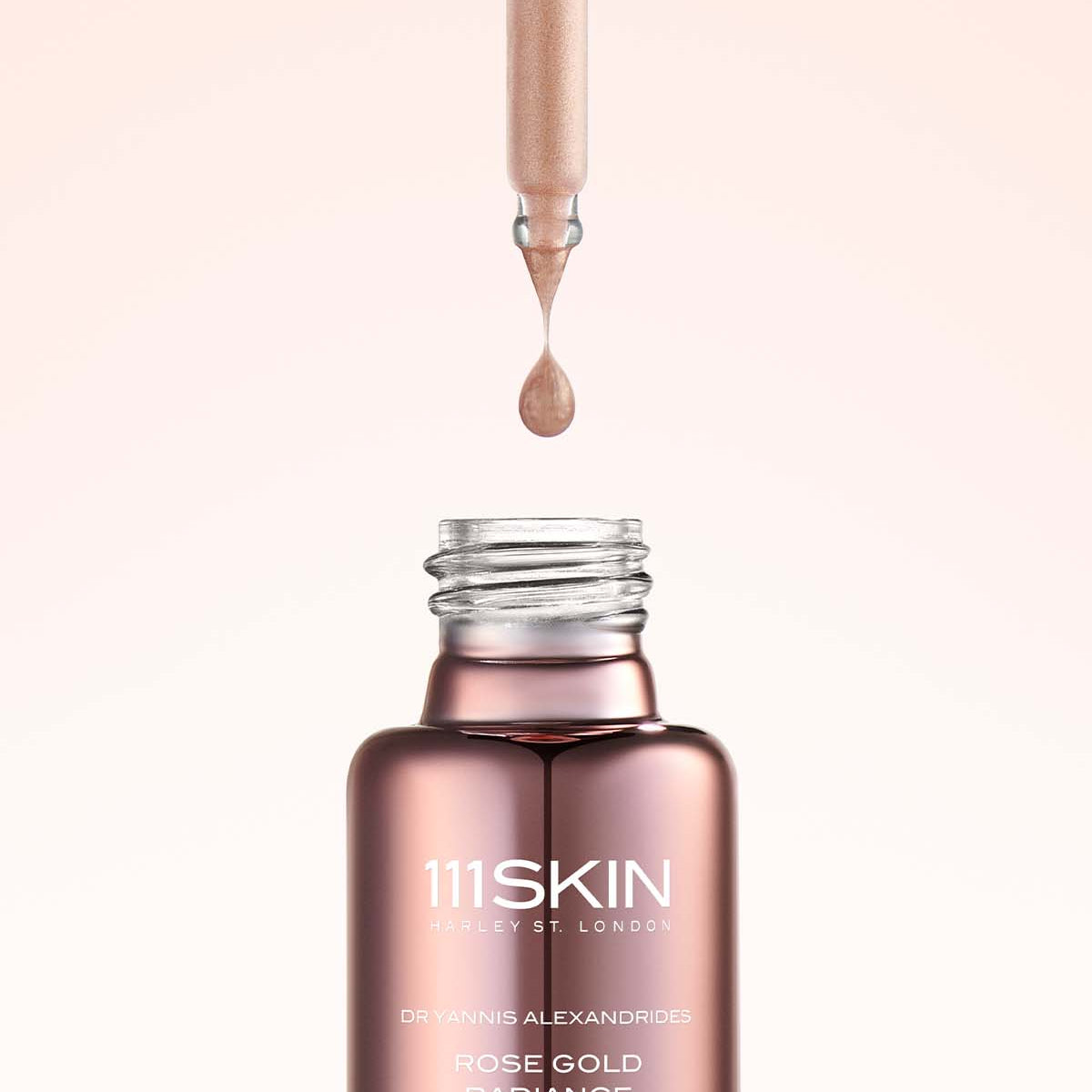
Rose Gold Radiance Booster provides immediate luminosity with a subtle shimmer, alongside hydration. For all-over radiance, shake and mix 1 to 2 drops with moisturiser in the morning. This belongs to the moisturising stage of the routine and gives a different result from the gradual tone improvement sought with vitamin C.
Keep the goal clear:
- For antioxidant care and gradual brightening: select a well-formulated vitamin C product and use it consistently.
- For visible dark spots and uneven tone: consider a targeted treatment such as Dark Spot Correcting Serum.
- For an immediately luminous finish: Rose Gold Radiance Booster adds hydration and subtle shimmer.
These benefits can overlap in a wider skincare routine, but they are not interchangeable. Selecting the result you actually want helps prevent unnecessary layering and makes progress easier to assess.
Troubleshooting vitamin C application
If the serum stings or leaves skin tight
Stinging is not evidence that vitamin C is working more effectively. Some L-ascorbic acid formulas are acidic and can feel uncomfortable, especially on sensitive or already irritated skin. The vitamin C form, concentration and surrounding ingredients all influence tolerance.
Stop use if irritation occurs. Once the skin is comfortable again, reassess the product and the rest of your routine before restarting or selecting a different formula. Persistent redness, itching or soreness warrants professional advice.
Do not assume the highest percentage is the best choice. Percentages of different vitamin C forms cannot be treated as equivalent measures of finished-product performance. A formula you can use comfortably and consistently is more useful than a stronger-feeling treatment you repeatedly have to stop.
If products pill under sunscreen or make-up
Pilling can reflect the amounts applied, the interaction between formulas or repeated rubbing as products settle. It does not necessarily mean that vitamin C has failed to absorb or that your sunscreen is unsuitable.
Start by checking the simplest variables:
- Use the directed amount of each product rather than adding extra serum.
- Allow each layer to settle enough for the next to spread evenly.
- Reduce unnecessary layers while keeping moisturiser and adequate sunscreen.
- Apply make-up gently, avoiding repeatedly working over the same area.
Change one variable at a time so you can identify what helps. Do not solve pilling by reducing sunscreen below its instructed application amount.
If you cannot see a change
Vitamin C is not an instant dark-spot eraser. Changes in uneven tone and visible lines generally develop over weeks to months, with timing influenced by the product, the concern and consistency. A brighter finish immediately after application may reflect hydration or texture.
If you want to track progress, take occasional photographs in similar lighting without make-up. Daily changes in daylight and skin hydration can make comparison unreliable. Keep expectations tied to the product's stated benefits and maintain daytime sun protection.
Also follow the formula's storage and period-after-opening directions. An unexpected change in colour, smell or texture is a reason to ask the manufacturer whether it remains suitable for use; a serum's original colour alone does not establish its condition.
Conclusion
For most vitamin C serums, the clearest starting point is morning application after cleansing, followed by moisturiser and sunscreen. Choose the formula first, follow its directions and build frequency around comfortable skin.
Before adding more products, identify your priority: antioxidant care, visible dark spots, hydration or immediate luminosity. Use that distinction to refine your routine, or use the 111SKIN skincare quiz to explore care matched to your main concerns. A clear treatment choice and a manageable application method make consistent use easier.
As with any skincare product, patch test before first use. If you are pregnant or breastfeeding, consult your doctor before using any skincare products.
FAQ
Should I use vitamin C before or after moisturiser?
A conventional vitamin C serum usually goes before moisturiser, after cleansing. A vitamin C cream belongs at the moisturising stage, while oil-based formulas may have different directions. Follow the method for the exact product you use.
Can I use vitamin C at night instead of in the morning?
Yes, if the formula is suitable for evening use. Morning is a useful first choice because vitamin C's antioxidant benefits complement daytime sunscreen. Consistent evening application is still worthwhile when it fits the product's directions and your routine.
Can I use vitamin C every day?
Many vitamin C products are designed for daily use. If you are new to the ingredient or have sensitive skin, introduce it gradually within the product's directions and increase only while skin remains comfortable. Stop use if irritation occurs.
How long should I wait between vitamin C and sunscreen?
There is no universal waiting time for every vitamin C formula. Let the serum settle, apply moisturiser, then apply sunscreen according to its own directions. Repair Sunscreen SPF50+ should be applied 15 to 20 minutes before sun exposure.